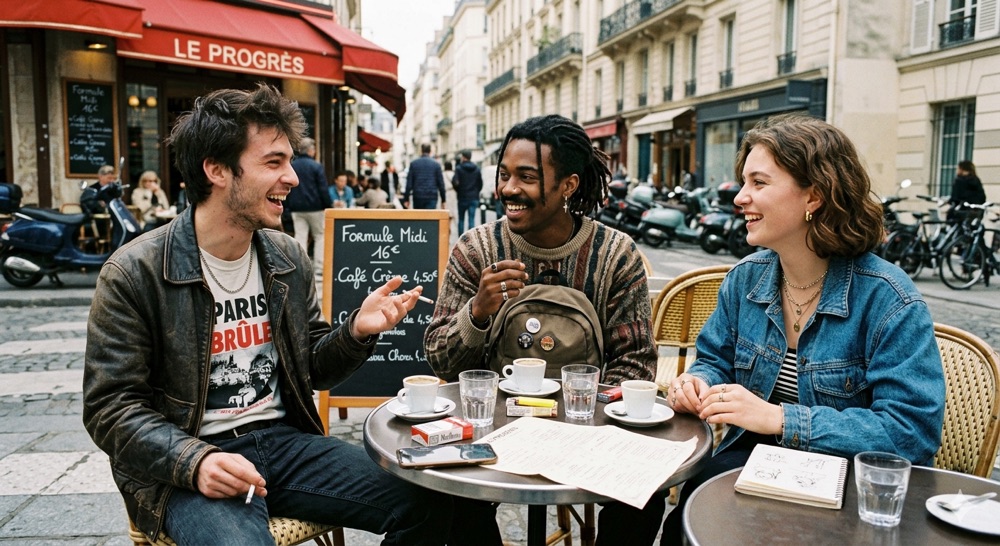
Did you know that, in real life, French people don't always speak the French you learn at school? In cafés, group chats, and banlieue courtyards, they swap textbook phrases for argot—French slang words for money, friends, cool, and just about everything else. Your ability to recognize that informal layer may be what turns tourist French into a real French-speaking experience.
It's interesting that argot or informal French sayings have long come from the margins of society. The first French slang words appeared in the fifteenth century. According to the Larousse dictionary, French argot is the special vocabulary that closed social groups—prisons, trades, the underworld—use to set themselves apart or hide from outsiders. Criminals encoded their activities into a secret language or jargon that only insiders could follow.
The most famous twist on modern French slang is verlan, a coded form of argot built by reversing syllables inside a word. Larousse notes that verlan itself is l'envers spoken backwards, and that everyday terms like meuf (woman) and ripou (corrupt cop, from pourri) spread from Paris street speech into mainstream conversation. The BBC's Cool French guides describe verlan as back-slang—the same process behind keum for mec (guy)—and mark those words with a "v" because they turn up constantly in films, rap lyrics, and texts.
French slang also shifts by region and generation. A pote in Lyon, a keum in Marseille, and a wesh in the suburbs can signal different moods in the same sentence. Texting has pushed French further still: abbreviations, borrowed English, and playful spelling pop up beside classic French argot in Snapchat threads and WhatsApp groups. None of this replaces standard French for exams or boardrooms—but if you want to laugh along with a native joke or read a caption without guessing, you need at least a handful of these words in your pocket.
But first, start learning French now so you can get the most out of your travels or language classes! French Translator Dictionary + by Vidalingua is one of the best apps for learning French, with comprehensive dictionaries, verb conjugations, real-time translator and a lot more. Download it for free on the App Store and Google Play.



Everything below is informal French—perfect with friends, out of place in a job interview. When you are unsure of the register, listen first and let context guide you.
blé
/ble/
The literal meaning is "wheat." Like English "bread" or "dough," grain words often stand in for cash in French slang.
🇫🇷 Nous dépensons beaucoup de blé pour nos vacances.
🇺🇸 We spend a lot of money on our holidays.
fric
/fʁik/
One of the most common French argot words for money in France. It has no literal meaning today—just everyday French slang for cash.
🇫🇷 Je n'ai pas de fric pour m'acheter une voiture.
🇺🇸 I don't have the money to buy a car.
flouse
/fluz/
It comes from the older Parisian argot word flouze. It is used for money, especially in street and working-class French.
🇫🇷 Les voleurs ont pris tout le flouse dans la caisse.
🇺🇸 The thieves took all the money from the cash register.
oseille
/ozɛj/
The literal meaning is "sorrel," the leafy herb. In French slang it means money—perhaps because sorrel was once sold for small change.
🇫🇷 Les étudiants gagnent de l'oseille grâce aux petits boulots d'été.
🇺🇸 Students earn money with summer jobs.
pèze
/pɛz/
It is verlan (back-slang) from spèze, itself slang for espèces (cash). It is very informal Parisian street French—typical verlan, where reversed syllables mark youth slang.
🇫🇷 File-moi du pèze.
🇺🇸 Give me some money.
pognon
/pɔɲɔ̃/
It comes from the idea of money you can grip in your fist (poing). It is common, slightly rough slang for cash.
🇫🇷 Je mets mon pognon à la banque.
🇺🇸 I put my money in the bank.
thune or tune
/tyn/ · /tyn/
It comes from an old French coin called the thune. It is now generic slang for money, especially among younger speakers.
🇫🇷 Jacques a perdu beaucoup de thunes au casino.
🇺🇸 Jack lost a lot of money at the casino.
pote
/pɔt/
It is short for copain (buddy). It is the go-to casual word for friend in modern spoken French.
🇫🇷 Thomas est mon meilleur pote.
🇺🇸 Thomas is my best friend.
poteau or poto
/pɔto/ · /pɔto/
These are playful variants of pote, used affectionately among close friends.
🇫🇷 Je pars en vacances avec un poteau.
🇺🇸 I'm going on vacation with a friend.
chouette
/ʃwɛt/
The literal meaning is "owl." In French slang it means great or cool—a positive word used by speakers of all ages.
🇫🇷 Mon nouveau prof est vraiment chouette.
🇺🇸 My new teacher is really cool.
cool
/kul/
It is borrowed from English and used the same way: fashionable, excellent, or relaxed.
🇫🇷 Ce groupe de rap est trop cool.
🇺🇸 This rap band is so cool.
super
/sypɛʁ/
This is standard French that doubles as casual slang for "great" or "cool" in quick reactions.
🇫🇷 Tu viens avec nous ? Super !
🇺🇸 You're coming with us? Cool!
Abbreviations for texts and DMs with people you tutoyer—not for emails to your boss.
MDR
/ɛm de ɛʁ/
It stands for mort de rire (dying of laughter)—the French equivalent of LOL. You will see it in texts, DMs, and comment threads when something is funny.
🇫🇷 C'était trop drôle, mdr !
🇺🇸 That was so funny, LOL!
PTDR
/pe te de ɛʁ/
It stands for pété de rire (burst out laughing)—stronger than MDR, like LMAO in English. Use it in texts and DMs when something really cracks you up.
🇫🇷 J'ai failli m'étouffer, ptdr.
🇺🇸 I almost choked laughing, LMAO.
OSEF
/o sɛn fu/
It stands for on s'en fout (we don't care)—a blunt way to say something does not matter to you. Common in texts and online comments—blunt, so know your audience.
🇫🇷 Osef, fais ce que tu veux.
🇺🇸 I don't care, do what you want.
TKT
/te kjet/
It stands for t'inquiète (don't worry)—a quick, reassuring reply in chats. The full phrase is t'inquiète pas.
🇫🇷 Tkt, je m'en occupe.
🇺🇸 Don't worry, I'll take care of it.
STP
/ɛs te pe/
It stands for s'il te plaît (please)—one of the most common texting abbreviations in France. Use SVP with people you address as vous.
🇫🇷 Envoie-moi la photo stp.
🇺🇸 Send me the photo please.
beu or beuh
/bø/ · /bø/
It is verlan for herbe (herb), meaning cannabis. It is very common in youth and hip-hop French—you'll hear it often before you ever need to say it.
🇫🇷 Les jeunes fument de la beuh en cachette.
🇺🇸 Young people smoke weed on the sly.
baba
/baba/
It means amazed, speechless, or flabbergasted. It is often used when something leaves you stunned—in a good or bad way.
🇫🇷 La petite fille danse si bien que j'en reste baba.
🇺🇸 The little girl is such a good dancer that I'm flabbergasted.
tise
/tiz/
This French argot word is for alcohol, especially cheap drinks or party booze. It is heard more among younger crowds.
🇫🇷 Je dois acheter de la tise pour la fête.
🇺🇸 I must buy some alcohol for the party.
piaule
/pjol/
Originally a henhouse (poulailler). It is now French slang for a small room or cramped flat, often near university.
🇫🇷 Claire loue une piaule près de la fac.
🇺🇸 Claire rents a small flat near the university.
se peler
/sə pəle/
The literal meaning is "to peel oneself." It is exaggerated French slang for freezing and is often said for comic effect.
🇫🇷 On va se peler si on n'allume pas le chauffage.
🇺🇸 We will be cold if we don't turn the heater on.
canon
/kanɔ̃/
It comes from the idea of a knockout blast. It is French slang for someone very attractive, usually about a person’s looks.
🇫🇷 Les mannequins sont souvent canon.
🇺🇸 Models are often beautiful.
binouse/binouze
/binuz/ · /binuz/
This is everyday French argot for beer. You’ll hear it constantly after work or at casual get-togethers.
🇫🇷 Allons boire une binouse après le travail.
🇺🇸 Let's go and have a beer after work.
bouquin
/bukɛ̃/
This is a familiar word for any book—fine among friends, less suited to formal writing or reviews.
🇫🇷 Je lis un bouquin sur la vie de Napoléon.
🇺🇸 I'm reading a book about Napoleon's life.
frangin
/fʁɑ̃ʒɛ̃/
This is affectionate slang for brother, warmer and more casual than frère. The tone depends on context, so listen for whether it sounds affectionate, teasing, or dismissive.
🇫🇷 Sophie a deux ans de moins que son frangin.
🇺🇸 Sophie is two years younger than her brother.
bagnole, caisse, gamos, tire
/baɲɔl/ · /kɛs/ · /ɡamos/ · /tiʁ/
Bagnole is the most universal French slang for car. Caisse literally means "box"; gamos and tire are less common regional variants.
🇫🇷 Tu dois amener ta bagnole chez le mécanicien.
🇺🇸 You have to take your car to the mechanic.
gamin(e), gosse, marmot, mioche, môme, moutard
/ɡamɛ̃/ · /ɡamin/ · /ɡɔs/ · /maʁmo/ · /mjɔʃ/ · /mom/ · /mutaʁ/
Familiar words for a kid. Gamin is mild; mioche can sound a bit dismissive depending on tone.
🇫🇷 La maîtresse essaie de calmer le gamin turbulent.
🇺🇸 The teacher tries to calm the turbulent child.
clope
/klɔp/
This is universal French slang for a cigarette—one of the most heard words in everyday spoken French.
🇫🇷 Les participants fument une clope pendant la pause.
🇺🇸 Attendees smoke a cigarette during the break.
fringues
/fʁɛ̃ɡ/
Casual clothes or outfits. Acheter des fringues is everyday shopping talk among friends.
🇫🇷 Je m'achète de nouvelles fringues pour l'été.
🇺🇸 I buy myself new clothes for the summer.
barré(e), cinglé(e), déjanté(e), dingue, ouf, taré(e)
/baʁe/ · /sɛ̃ɡle/ · /deʒɑ̃te/ · /dɛ̃ɡ/ · /uf/ · /taʁe/
These are words for crazy or nuts. Ouf is verlan for fou (mad); intensity ranges from playful to harsh.
🇫🇷 Sa réaction démesurée est complètement dingue.
🇺🇸 His excessive reaction is totally crazy.
clébard, clebs
/klebaʁ/ · /klɛbs/
Rough or affectionate French slang for a dog, often a mutt. Clebs is the shortened form.
🇫🇷 Le clébard aboie quand il voit le facteur.
🇺🇸 The dog barks when he sees the postman.
clampser, clamser, crever
/klɑ̃pse/ · /klɑ̃se/ · /kʁəve/
Hyperbolic French slang for dying—usually means exhausting yourself, not literal death. Crever also means to burst or pop.
🇫🇷 Je vais clamser si je continue à courir !
🇺🇸 I'll die if I keep running!
toubib
/tubib/
It is short for medical (médical → toubib). It is friendly, widely used French slang for a doctor.
🇫🇷 Paul va chez le toubib car il a mal à la gorge.
🇺🇸 Paul goes to the doctor because his throat aches.
picoler
/pikɔle/
This verb means to booze or drink alcohol, often with the idea of drinking a bit too much. It is informal but very common.
🇫🇷 Je ne picole jamais avant de conduire.
🇺🇸 I never drink before driving.
bourré(e), charasse, torché(e)
/buʁe/ · /ʃaʁas/ · /tɔʁʃe/
This slang word is for drunk. Torché suggests someone is well and truly wasted.
🇫🇷 Tom est bourré tous les samedis soir.
🇺🇸 Tom is drunk every Saturday night.
béqueter, bouffer, grailler
/bekəte/ · /bufe/ · /ɡʁaje/
Casual verbs for eating. Bouffer is the everyday favorite; grailler is more street and youth slang.
🇫🇷 Nous aimons bouffer au restaurant le dimanche.
🇺🇸 We like to eat at the restaurant on Sundays.
mirette
/miʁɛt/
This French argot word is for eye, usually plural (mirettes). Old thieves’ slang that stuck in colloquial French.
🇫🇷 Sandra a les mêmes mirettes bleues que sa mère.
🇺🇸 Sandra has the same blue eyes as her mother.
bouille, tronche
/buj/ · /tʁɔ̃ʃ/
This slang word is for face. Tronche is blunt and often humorous.
🇫🇷 Ses lunettes lui font une drôle de tronche !
🇺🇸 He has a funny face with his glasses on!
chocottes, frousse, jetons, trouille
/ʃɔkɔt/ · /fʁus/ · /ʒətɔ̃/ · /tʁuj/
This slang word is for fear or the creeps. Avoir la trouille is as common as "to be scared" in English.
🇫🇷 Elle a une trouille incontrôlable des souris.
🇺🇸 She has an uncontrollable fear of mice.
poiscaille
/pwaskaj/
It comes from poisson (fish). Colloquial word for fish, often when complaining about bones at the table.
🇫🇷 Il y a beaucoup d'arêtes dans le poiscaille.
🇺🇸 There are many bones in the fish.
panard
/panaʁ/
This slang word is for foot, usually plural (panards). It is heard in everyday complaints about shoes or walking.
🇫🇷 Mes chaussures neuves me font mal aux panards.
🇺🇸 My feet hurt because of my new shoes.
gonzesse, meuf, nana
/ɡɔ̃zɛs/ · /mœf/ · /nana/
This slang word is for girl or girlfriend. Meuf is verlan for femme (woman).
🇫🇷 Sam est très amoureux de sa nouvelle meuf.
🇺🇸 Sam is very in love with his new girl.
flingue
/flɛ̃ɡ/
This slang word is for gun. Common in films and crime talk—recognize it, but never toss it around lightly.
🇫🇷 Le braqueur menace les otages avec un flingue.
🇺🇸 The robber threatens the hostages with a gun.
tif
/tif/
This word means hair, usually in the plural (tifs). Standard salon and barbershop slang.
🇫🇷 Le coiffeur me coupe les tifs.
🇺🇸 The hairdresser cuts my hair.
louche, menotte, mimine, paluche, pogne
/luʃ/ · /mənɔt/ · /mimin/ · /palyʃ/ · /pɔɲ/
This slang word is for hand. Paluche is common for shaking hands (serrer la paluche).
🇫🇷 Nous nous serrons la paluche pour conclure l'affaire.
🇺🇸 We shake hands to close the deal.
caboche
/kabɔʃ/
This slang word is for head. It is often used for a headache (mal à la caboche).
🇫🇷 La chaleur me donne mal à la caboche.
🇺🇸 The heat gives me a headache.
canasson
/kanasɔ̃/
It literally means an old or worn-out horse. Slang borrowed into racing and betting talk.
🇫🇷 Le vieux canasson a perdu la course.
🇺🇸 The old horse lost the race.
baraque, bicoque
/baʁak/ · /bikɔk/
Baraque can mean home or a rickety building; bicoque suggests a shabby little place.
🇫🇷 Nous emménageons dans notre nouvelle baraque demain !
🇺🇸 We are moving into our new house tomorrow!
vénère
/venɛʁ/
It is verlan for énervé (annoyed). Means irritated, fed up, or upset.
🇫🇷 Je suis vénère parce que mon train a été annulé.
🇺🇸 I am irritated because my train has been cancelled.
bidouiller
/biduje/
This verb means to tinker, hack, or knock something together. It implies an improvised, DIY fix.
🇫🇷 Sam a bidouillé le moteur de sa voiture.
🇺🇸 Sam knocked the engine of his car up.
baveux
/bavø/
The literal meaning is "drooly," which is why the word sounds mocking. It is old slang for a lawyer and is not especially flattering.
🇫🇷 Le baveux essaie de convaincre le jury.
🇺🇸 The lawyer tries to convince the jury.
dégager, se casser, se tirer
/deɡaʒe/ · /sə kase/ · /sə tiʁe/
This slang word is for getting out or leaving. Se casser is very common among friends.
🇫🇷 Ils se sont cassés à cause du bruit.
🇺🇸 They left because of the noise.
guibole
/ɡibɔl/
This is a playful or slightly old-fashioned slang word for a leg.
🇫🇷 Il s'est cassé la jambe au ski.
🇺🇸 He broke his leg skiing.
kifer, kiffer
/kife/ · /kife/
It comes from North African–influenced slang and means to love or really enjoy something. It is ubiquitous among young French speakers.
🇫🇷 Les jeunes kiffent ce groupe de rap.
🇺🇸 Young people like this rap group.
se gourer, se planter
/sə ɡuʁe/ · /sə plɑ̃te/
These slang verbs mean to mess up or get something wrong. Je me suis gouré is an everyday admission of a mistake.
🇫🇷 Je me suis gourée en lisant les instructions.
🇺🇸 I made a mistake when I read the instructions.
gars, keum, mec, type
/ɡa/ · /kœm/ · /mɛk/ · /tip/
These are words for guy or man. Keum is verlan for mec; mec is the standard informal choice.
🇫🇷 Les mecs jouent au foot dans le jardin.
🇺🇸 The men play soccer in the garden.
bidoche
/bidɔʃ/
This slang word is for meat, especially the kind you throw on a barbecue.
🇫🇷 Nous préparons la bidoche pour le barbecue.
🇺🇸 We prepare the meat for the barbecue.
meule
/mœl/
The literal meaning is "millstone." Slang for a moped or small motorcycle, often modified by teenagers.
🇫🇷 Les ados font rugir leur meule modifiée.
🇺🇸 Teenagers make their modified moped roar.
belle-doche
/bɛl dɔʃ/
It is verlan for belle-mère (mother-in-law). A very common family nickname.
🇫🇷 Je m'entends très bien avec ma belle-doche.
🇺🇸 I get on very well with my mother-in-law.
balaise, balèze, baraqué(e), costaud
/balɛz/ · /balɛz/ · /baʁake/ · /kɔsto/
This slang word is for strong, beefy, or muscular. Balaise can also mean impressive or powerful.
🇫🇷 Il est baraqué depuis qu'il fait du sport.
🇺🇸 He got muscular since he started exercising.
blase
/blaz/
This French argot word is for name or nickname—not to be confused with blasé (bored or jaded).
🇫🇷 Le blase de mon voisin est Dupont.
🇺🇸 My neighbor's name is Dupont.
blair, pif, tarin
/blɛʁ/ · /pif/ · /taʁɛ̃/
This slang word is for nose. Pif is the one you’ll hear most in casual speech.
🇫🇷 Elle a un bouton sur le pif.
🇺🇸 She has a spot on her nose.
zinc
/zɛ̃k/
Originally the zinc bar counter in a café. By extension, ironic slang for an airplane.
🇫🇷 Le zinc décollera à 10h.
🇺🇸 The plane will take off at 10 am.
flic, keuf, poulet
/flik/ · /kœf/ · /pulɛ/
This slang word is for cop. Keuf is verlan for flic; poulet literally means chicken.
🇫🇷 Le flic lui demande ses papiers d'identité.
🇺🇸 The policeman asks him for his ID.
flotter
/flɔte/
This is a colloquial French slang verb for rain. Il flotte means it’s pouring or drizzling—very informal weather talk.
🇫🇷 Je prends mon parapluie parce qu'il flotte.
🇺🇸 I take my umbrella because it's raining.
casse-dalle
/kas dal/
This French slang means a quick lunch snack, often a sandwich. The name suggests breaking hunger (dalle = slab/hunger).
🇫🇷 Les ouvriers déjeunent avec un casse-dalle.
🇺🇸 The workers eat a sandwich for lunch.
bahut, boîte
/bay/ · /bwat/
This slang word is for high school. Boîte literally means box—your daily grind.
🇫🇷 Les élèves arrivent au bahut à 8h30.
🇺🇸 Students arrive at high school at 8.30 am.
godasse
/ɡɔdas/
This word means a shoe, usually a casual or worn one. It is often plural (godasses).
🇫🇷 Hélène porte toujours des godasses à talons.
🇺🇸 Helen always wears heel shoes.
frangine
/fʁɑ̃ʒin/
Affectionate French slang for sister—the female counterpart to frangin.
🇫🇷 Ma frangine et moi échangeons souvent nos vêtements.
🇺🇸 My sister and I often swap clothes.
pioncer, roupiller
/pjɔ̃se/ · /ʁupije/
These slang verbs mean to sleep or nap heavily. Pioncer suggests sleeping like a log.
🇫🇷 J'ai pioncé toute la nuit comme un bébé.
🇺🇸 I slept all night like a baby.
chouraver, chourer, piquer
/ʃuʁave/ · /ʃuʁe/ · /pike/
These slang verbs mean to swipe or steal. Piquer is lighter slang also used for borrowing without asking.
🇫🇷 Quelqu'un a chouré mon portefeuille.
🇺🇸 Someone stole my wallet.
dauber, schlinguer
/dobe/ · /ʃlɛ̃ɡe/
These slang verbs mean to reek or stink badly. Hyperbolic and vivid—used when something smells awful.
🇫🇷 Cette viande pourrie daube dans toute la maison.
🇺🇸 This rotten meat stinks all over the house.
causer, jacter
/koze/ · /ʒakte/
These slang verbs mean to chat or yap. Causer is warm and sociable; jacter implies talking a lot.
🇫🇷 Nous causons de la situation pendant l'apéro.
🇺🇸 We talk about the situation while having a drink.
couilles (vulgar), burnes (vulgar), roubignoles, roupettes, roustons
/kuj/ · /byʁn/ · /ʁubiɲɔl/ · /ʁupɛt/ · /ʁustɔ̃/
This is vulgar slang for testicles—very crude. Use only if you fully understand how offensive it can be.
🇫🇷 Une selle trop dure fait mal aux roupettes.
🇺🇸 A hard saddle hurts the testicles.
chiottes (vulgar)
/ʃjɔt/
This is a vulgar word for toilet or bathroom—fine among mates, not with strangers.
🇫🇷 Les chiottes publiques sont souvent sales.
🇺🇸 Public toilets often are dirty.
biter, bitter, capter, piger
/bite/ · /bite/ · /kapte/ · /piʒe/
These slang verbs mean to get it or understand. Je pige is as common as "I get it" in English.
🇫🇷 Je ne pige rien malgré ton explication.
🇺🇸 I don't get it despite your explanation.
dégueuler, dégobiller, gerber
/deɡœle/ · /deɡɔbije/ · /ʒɛʁbe/
These are vulgar verbs for vomiting—graphic and informal, often after a rough night out.
🇫🇷 L'ivrogne a dégueulé sur le trottoir.
🇺🇸 The drunkard vomited on the sidewalk.
flotte
/flɔt/
This slang word is for water. Boire un verre de flotte is plain, casual speech.
🇫🇷 Je bois un grand verre de flotte pour me désaltérer.
🇺🇸 I drink a big glass of water to quench my thirst.
pinard, pive
/pinaʁ/ · /piv/
This phrase refers to cheap or everyday wine. Pinard has working-class roots; pive is less common.
🇫🇷 Le Bordeaux est mon pinard préféré.
🇺🇸 Bordeaux is my favorite wine.
boulot, taf, turbin
/bulo/ · /taf/ · /tyʁbɛ̃/
This is French slang for job or work. Boulot is the most universal; taf comes from Arabic-influenced slang.
🇫🇷 J'ai trouvé un petit boulot pour payer mes études.
🇺🇸 I found an odd job to pay for my studies.
bosser, charbonner, taffer
/bose/ · /ʃaʁbɔne/ · /tafe/
These slang verbs mean to work hard. Bosser is standard informal French everywhere in France.
🇫🇷 Je dois bosser dur pour gagner de l'argent.
🇺🇸 I have to work hard to make money.
calendos
/kalɑ̃dos/
This French argot word is for Camembert cheese, from the brand name. A playful word for France’s favorite round cheese.
🇫🇷 Le calendos est mon fromage préféré.
🇺🇸 Camembert cheese is the one I prefer.
Boire un pot/un coup
/bwaʁ‿ɛ̃ pɔ/ · /bwaʁ‿ɛ̃ ku/
This phrase means "to have a drink." It is a casual way to suggest meeting for a beer, coffee, or quick drink with friends.
Ça craint.
/sa kʁɛ̃/
This phrase means "that sucks." Use it when something feels disappointing, worrying, or clearly not good.
Ça déchire !
/sa deʃiʁ/
This enthusiastic phrase means "it rocks!" or "that is awesome!" It is very informal and works well for music, parties, performances, or anything impressive.
Ça marche.
/sa maʁʃ/
This phrase means "that works" or "okay." It is one of the most useful casual phrases when you agree to a plan.
Ça me saoule. or Ça me gonfle.
/sa mə sul/ · /sa mə ɡɔ̃fl/
These phrases mean "that pisses me off" or "that is really annoying." They are informal complaints, so avoid them in polite or professional settings.
Ça passe crème.
/sa pas kʁɛm/
This phrase means "it goes off without a hitch." Literally it suggests something passing smoothly, like cream, and is common in relaxed speech.
Carrément !
/kaʁemɑ̃/
This phrase means "straight up!" or "you bet!" It adds strong agreement and sounds more emphatic than a simple oui.
C’est de la balle !
/sɛ də la bal/
This phrase means "it’s fantastic!" It is very casual and a bit playful, often used to praise something exciting or fun.
C’est chelou.
/sɛ ʃlu/
This phrase means "it’s weird." Chelou is verlan for louche, so it gives the sentence a streetwise, informal tone.
C’est clair !
/sɛ klɛʁ/
This phrase literally means "it is clear," but in conversation it means "totally!" or "you don’t say!" Use it to agree strongly with someone.
C'est le pied !
/sɛ lə pje/
This phrase means "it rocks!" or "it feels great." Literally it says "it is the foot," but the real meaning is pleasure or satisfaction.
C’est nul.
/sɛ nyl/
This phrase means "that sucks" or "that is lame." It is a common everyday phrase to criticize a bad idea, bad movie, or disappointing situation.
C’est un truc de ouf !
/sɛtœ̃ tʁyk də uf/
This phrase means "that’s crazy stuff!" Ouf is verlan for fou, so the expression sounds energetic and very informal.
Crever la dalle
/kʁəve la dal/
This phrase means "to be starving." It is a vivid informal expression for being extremely hungry, not just a little ready for lunch.
Elle/Il se la pète trop !
/ɛl sə la pɛt tʁo/ · /il sə la pɛt tʁo/
This phrase means "she or he thinks they’re hot stuff." Use it to criticize someone who is showing off or acting arrogant.
Être grillé(e)
/ɛtʁ gʁije/
This phrase means "to be toast" or "to be caught." It can describe someone whose lie, secret, or mistake has been exposed.
Être au taquet
/ɛtʁ o takɛ/
This phrase means "to be on fire" or fully ready. It describes someone who is energetic, focused, and operating at full speed.
Ferme ta gueule ! or Ferme-la ! or Ta gueule !
/fɛʁm ta gœl/ · /fɛʁm la/ · /ta gœl/
These phrases mean "shut the hell up!" They are aggressive and rude, so understand them for recognition but avoid using them unless you know the situation very well.
Génial !
/ʒenjal/
This phrase means "awesome!" or "great!" It is positive, common, and safe in most casual conversations.
Jamais de la vie.
/ʒamɛ də la vi/
This phrase means "no way." Literally it says "never in life," which makes the refusal sound stronger and more dramatic.
Lâche-moi la grappe/les basques/les baskets.
/laʃ mwa la gʁap/ · /laʃ mwa le bazk/ · /laʃ mwa le basket/
These phrases mean "give me a break" or "leave me alone." They are informal ways to tell someone to stop bothering you.
Laisse tomber !
/lɛs tɔ̃be/
This phrase means "forget it!" or "drop it!" Use it when you want to abandon a plan, subject, or argument.
Ne pas se louper
/n(ə) pa s(ə) lupe/
This phrase means "not to screw everything up" or "not to miss your chance." It is informal and often used when the stakes feel high.
Non mais sans déc ! or Sans déconner !
/nɔ̃ mɛ sɑ̃ dɛk/ · /sɑ̃ dekɔne/
These phrases mean "cut the crap!" or "seriously?" They can show disbelief, annoyance, or surprise depending on tone.
Pas de souci.
/pa də susi/
This phrase means "no problem." It is friendly, common, and useful when accepting a request or reassuring someone.
Point barre !
/pwɛ̃ baʁ/
This phrase means "period!" or "end of story!" Use it when you want to close a discussion firmly.
Se prendre une murge
/sə pʁɑ̃dʁ yn myʁʒ/
This phrase means "to get wasted." It is informal party language for drinking far too much alcohol.
Top ! or Nickel !
/tɔp/ · /nikɛl/
These phrases mean "great!" or "perfect!" They are very common when confirming that something works or looks good.
Have you written an article about learning French? Email
outreach@vidalingua.com to let us know. We might link to it!
Looking for lessons with interactive exercises to practice speaking? Download
Learn French + for free on your iPhone or iPad.
À plus dans le bus ! (See you later alligator!)
Christine Ducos-Restagno
Lead French Linguist
VidaLingua
Want to speak French like a native? Mastering French idioms helps you understand expressions whose meaning goes beyond the literal translation.
Listening to French songs is a fun way to build vocabulary, improve pronunciation, and hear natural rhythm from classic and modern artists.
Mastering French verb conjugation is essential for speaking clearly. This guide covers key patterns for verbs like être, avoir, and more.



© vidalingua